
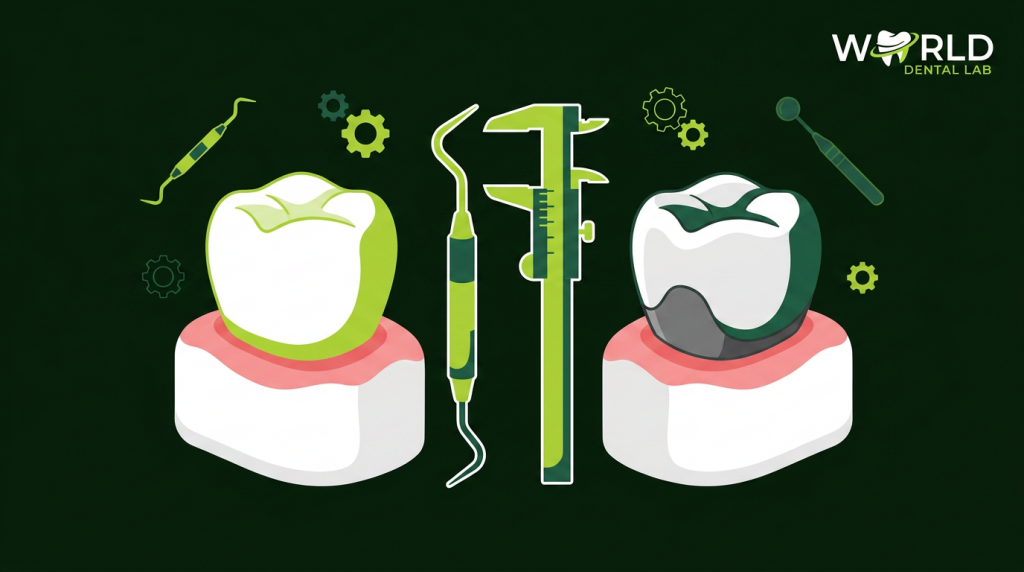
For decades, the porcelain-fused-to-metal (PFM) crown was the workhorse of restorative dentistry. Strong, reasonably aesthetic, and predictable — PFM seemed untouchable. Then monolithic zirconia arrived, and quietly, case by case, it began winning the argument.
Today, most dental labs process more zirconia units than PFM. But that doesn’t mean PFM is dead or that zirconia is always the right answer. The clinical decision is more nuanced than material trends suggest.
This guide breaks down every meaningful difference between monolithic zirconia and PFM crowns — from lab workflow to long-term clinical outcomes — so you can match the material to the case, not the trend.
What Is Monolithic Zirconia?
Monolithic zirconia is a crown milled from a single block of zirconium dioxide — no layered porcelain on top. The term “monolithic” simply means the restoration is made from one continuous material throughout.
Modern monolithic zirconia comes in several generations:
- 3Y-TZP (3 mol% yttria-stabilized zirconia): The original high-strength formulation. Flexural strength of 900–1,200 MPa. Opaque, best for posterior load-bearing cases.
- 4Y-TZP / 5Y-TZP (high-translucency zirconia): Increased translucency at some reduction in strength (600–800 MPa). Suitable for anterior and premolar cases where aesthetics matter.
- Gradient/multilayer zirconia: Combines high strength at the cervical with high translucency at the incisal. Used for anterior cases demanding both strength and natural appearance.
What Is a PFM Crown?
A porcelain-fused-to-metal (PFM) crown has a cast metal substructure — typically a base metal alloy (nickel-chromium or cobalt-chromium) or precious metal (gold) — with hand-layered feldspathic or pressed porcelain baked on top.
PFM technology dates to the 1960s and was the standard for fixed prosthodontics for nearly fifty years. The metal coping provides structural support while the porcelain provides tooth-colored aesthetics.
Monolithic Zirconia vs PFM: Head-to-Head Comparison
| Property | Monolithic Zirconia | PFM Crown |
|---|---|---|
| Flexural strength | 600–1,200 MPa (varies by generation) | 300–450 MPa (porcelain layer) |
| Fracture resistance | Excellent — no porcelain to chip | Porcelain chipping is a known failure mode (5–10% at 5 years) |
| Translucency | Low (3Y) to moderate-high (5Y) | High — layered porcelain matches natural tooth well |
| Aesthetics (anterior) | Good with HT/multilayer; limited depth of characterization | Excellent with skilled ceramist; full color/value range |
| Tooth preparation | Minimal (0.5–1.0 mm occlusal reduction possible) | More aggressive — 1.5–2.0 mm occlusal, 1.0–1.5 mm axial |
| Lab turnaround | 1–3 days (milled same day in digital workflow) | 4–7 days (casting + bake cycle) |
| Lab cost (offshore) | $18–35/unit | $25–55/unit (base metal); $80–200/unit (precious) |
| Wear on opposing teeth | Low with polished surface; higher if glazed rough | Moderate-high for porcelain; low for metal contact areas |
| Metal allergy risk | None | Possible with base metals (Ni, Cr, Co) |
| MRI compatibility | Fully compatible | Not compatible — metal artifact in imaging |
| Longevity (10-year data) | 96–98% survival (posterior) | 90–95% survival (chipping excluded) |
Where Monolithic Zirconia Wins
Posterior High-Load Cases
Molar crowns take the most punishment in the mouth. A 3Y-TZP monolithic zirconia crown at 900+ MPa flexural strength simply won’t fracture under normal occlusal loads — something that can’t be said for the porcelain layer on a PFM, which chips in roughly 5–10% of cases over five years.
For bruxers and patients with high occlusal forces, monolithic zirconia is the evidence-based choice. Some clinicians even prefer it over full-cast metal in high-load posterior cases because it eliminates the electrogalvanic sensitivity some patients report with multiple metals in the mouth.
Minimal Prep Cases
Zirconia’s strength allows thinner profiles — as little as 0.5 mm occlusally in some systems. PFM requires adequate bulk for both the metal coping and the porcelain layer, demanding more tooth reduction. In cases where preserving tooth structure is a priority, monolithic zirconia allows more conservative preparations.
Patients with Metal Sensitivities
Nickel and cobalt allergy affects an estimated 10–15% of the population. For these patients, base-metal PFM crowns are contraindicated. Monolithic zirconia contains no metal and has been shown to be biocompatible in multiple long-term studies.
Digital-Only Workflows
If your practice uses an intraoral scanner and your lab is equipped with CAD/CAM milling, monolithic zirconia fits the workflow with zero manual steps — scan, design, mill, polish, deliver. Modern dental lab outsourcing is built around this workflow. PFM requires casting and multiple manual firing cycles that can’t be fully automated.
Where PFM Still Has an Argument
High-Aesthetic Anterior Cases with Demanding Patients
A skilled ceramist with quality feldspathic porcelain can achieve natural depth, characterization, and fluorescence that multi-layered zirconia currently cannot fully replicate. For anterior cases where the patient will scrutinize shade matching against natural teeth in photographs, PFM with a talented technician — or better yet, pressed e.max — remains competitive for pure aesthetics.
That said, 5Y-TZP and multilayer gradient zirconia have closed this gap significantly. Many cases previously reserved for PFM or e.max can now be handled by high-translucency zirconia at lower cost.
Full-Metal or Metal Occlusal Options Needed
In cases where wear concerns or opposing prosthetics demand specific occlusal contacts — such as cases opposing complete dentures — a metal occlusal PFM or full-cast crown is still indicated. Zirconia cannot replicate the low-wear, self-lubricating properties of polished gold in these scenarios.
Long-Span Bridges (5+ Units)
For very long-span bridges, PFM with a well-designed metal framework remains a predictable option with decades of clinical evidence. Monolithic zirconia bridges are routinely made up to 4 units, but evidence for longer spans in monolithic form is still accumulating. Layered zirconia or PFM is often preferred by labs for spans exceeding 5 units.
The Aesthetics Question: How Close Is Zirconia to PFM?
This is where the debate becomes most nuanced. Early-generation zirconia (pre-2015) was notoriously opaque — it looked like a white tooth but lacked the optical complexity of natural enamel. Modern high-translucency zirconia is a different material.
Today’s 5Y-TZP zirconia transmits light in a way that creates natural-looking depth, particularly in premolars and canines. Staining and glazing techniques have also advanced, allowing technicians to add characterization that was impossible with first-generation material.
For central incisors where precise shade matching is critical? PFM or e.max still has the aesthetic edge in the hands of an experienced ceramist. For most other cases? Modern zirconia is clinically acceptable and often preferred by patients who want a metal-free restoration.
Lab Workflow: Why Zirconia Is Faster and Cheaper
The production difference is significant. A PFM crown requires:
- Impression or scan received
- Die trimming and articulation
- Wax pattern fabrication
- Investing and casting the metal coping
- Finishing and fitting the casting
- Multiple porcelain layering and firing cycles (typically 3–5 firings)
- Final glaze and polish
A monolithic zirconia crown from a digital scan requires:
- Digital scan received
- CAD design (15–30 minutes)
- Milling (20–40 minutes)
- Sintering (90–120 minutes)
- Polishing and staining/glazing (30 minutes)
The zirconia workflow is objectively faster, requires fewer skilled manual steps, and produces consistent results across technicians. This is why offshore dental lab pricing for zirconia is typically 30–50% lower than equivalent PFM.
Clinical Decision Guide: Choosing Between Zirconia and PFM
Use this framework when selecting between the two materials:
| Clinical Situation | Recommended Material |
|---|---|
| Posterior molar, high occlusal load | Monolithic zirconia (3Y-TZP) |
| Bruxer or parafunctional habits | Monolithic zirconia (3Y-TZP) |
| Premolar, aesthetic zone | Monolithic HT zirconia or e.max |
| Upper anterior, critical shade matching | Layered zirconia, e.max, or PFM with skilled ceramist |
| Patient with metal allergy | Monolithic zirconia (any generation) |
| Implant crown, posterior | Monolithic zirconia |
| 3–4 unit bridge, posterior | Zirconia framework (layered or monolithic) |
| 5+ unit bridge | PFM or layered zirconia with metal framework |
| Opposing complete denture | Gold or metal occlusal PFM |
| Digital-only workflow | Monolithic zirconia |
What Offshore Dental Labs Recommend in 2026
Dental labs working internationally have seen the shift clearly. At World Dental Lab, our case mix in 2026 is approximately 65% monolithic zirconia, 18% layered zirconia or zirconia-porcelain, 10% e.max, and only 7% PFM. That ratio reflects what dentists are choosing after discussing the tradeoffs with their patients.
When dentists ask us which material to choose, our answer depends on the case:
- Default posterior: Monolithic zirconia. Stronger, faster, cheaper, no chipping risk.
- Aesthetic anterior: HT or multilayer zirconia first. Escalate to e.max if shade demands require it.
- Long-span bridge: Still evaluate PFM or layered zirconia based on span and loading.
See the full PFM vs zirconia clinical comparison and our guide to e.max vs zirconia for specific case scenarios involving all three materials.
Frequently Asked Questions
Is monolithic zirconia better than PFM?
For most posterior cases, yes — monolithic zirconia is stronger, less prone to failure, requires less tooth reduction, and costs less to fabricate. For high-aesthetic anterior cases requiring precise shade matching, PFM with layered porcelain or e.max may still be preferred by some clinicians and patients.
Does monolithic zirconia wear opposing teeth?
Properly polished monolithic zirconia causes minimal wear to opposing natural teeth — comparable to or less than glazed porcelain. Unpolished or rough zirconia surfaces are more abrasive, which is why polishing protocol matters. Always specify mirror-polished zirconia to your lab, especially for posterior cases.
Can you tell the difference between zirconia and a natural tooth?
With modern high-translucency (5Y-TZP) and gradient zirconia, most patients and even many dentists cannot easily distinguish the restoration from natural teeth in premolar and molar positions. In anterior positions under close examination, the absence of internal mamelons and some fluorescence differences may be visible, which is why the most demanding anterior aesthetics cases still use e.max or layered zirconia.
How long does a zirconia crown last compared to PFM?
Ten-year survival data shows monolithic zirconia at 96–98% (posterior) versus approximately 90–95% for PFM when chipping events are included. Zirconia does not chip because it has no layered porcelain. The primary failure mode for monolithic zirconia is fracture, which is rare in adequately thick restorations.
What is the cost difference between zirconia and PFM at a dental lab?
Offshore lab pricing (2026): monolithic zirconia runs $18–35 per unit; PFM with base metal $25–55 per unit; PFM with semi-precious or precious metal $80–200+ per unit. Domestic US lab pricing is 3–5x higher for both. See our full dental lab outsourcing cost guide for pricing by material and restoration type.
