
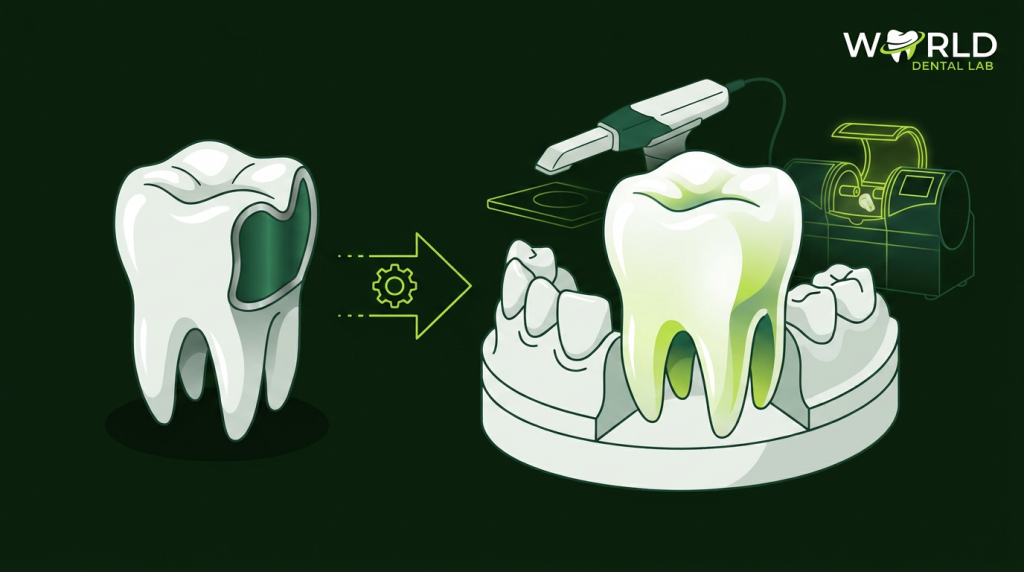
Porcelain-fused-to-metal crowns dominated dentistry for half a century. For most of that time, they were the gold standard — proven, reliable, and backed by decades of clinical outcomes. By the mid-2010s, the shift had already begun. By 2026, monolithic zirconia is the dominant material in most dental labs globally for posterior crowns, and PFM volume continues to decline year over year.
This isn’t a marketing story — it’s a material science story, a clinical story, and a lab workflow story. Understanding each angle tells you when to make the switch and when (if ever) PFM still makes sense.
The Material Science Case
What Changed With Zirconia
Early zirconia (3Y-TZP, 3 mol% yttria-stabilized tetragonal zirconia polycrystal) was opaque white and had poor aesthetics — fine for substructures, poor for full-coverage aesthetic restorations. The material had extraordinary strength (900–1200 MPa flexural strength) but looked nothing like natural tooth.
The breakthrough was multi-layer zirconia and high-translucency formulations. 4Y-TZP and 5Y-TZP (4–5 mol% yttria) trade some strength (600–900 MPa) for significantly increased translucency — approaching natural enamel in some formulations. Multi-layer milling discs build in a gradient from opaque A2 in the dentin zone to translucent incisal — matching natural tooth structure in a single milled block.
The result: a single material that provides structural strength, natural optical properties, and chemical stability — in one piece, with no bonding interface between a core and a veneer layer.
PFM’s Inherent Structural Limitation
PFM is a bilayer system: a cast metal substructure with sintered feldspathic porcelain baked on top. The fundamental weakness is the porcelain-metal bond — an interface between two materials with different coefficients of thermal expansion. Stresses accumulate at that interface over the restoration’s lifespan. The clinical consequence: porcelain chipping.
Published data puts PFM chipping/fracture rates at 3–7% at 5 years in high-stress posterior locations — a non-trivial failure mode that typically requires a new crown, not a repair. Monolithic zirconia has no bonding interface to fail.
The Clinical Outcomes Evidence
| Metric | PFM Crown | Monolithic Zirconia Crown |
|---|---|---|
| Flexural strength | Metal: 400–500 MPa; Porcelain: 60–80 MPa | 600–1,200 MPa (varies by formulation) |
| 5-year survival | ~95% (but ~4% chipping) | ~97–99% (fracture extremely rare) |
| 10-year survival | ~90–92% | Limited data; strong 5-year base |
| Chipping/fracture | 3–7% at 5 years (porcelain chip) | <0.5% (monolithic; no veneer layer) |
| Opposing tooth wear | Low to moderate (polished porcelain) | Low (polished zirconia); higher if unpolished |
| Gingival response | Variable; metal margins can irritate | Generally favorable; biocompatible |
| Metal allergy risk | Exists (nickel, cobalt in base metals) | None |
| Radiographic appearance | Metal substructure visible (artifact) | Radiopaque but distinct from metal |
The Lab Workflow Case
PFM Manufacturing Is Complex and Labor-Intensive
PFM manufacturing involves lost-wax casting (wax-up → investment → burnout → casting → divesting → sandblasting), metal finishing, opaquing, multiple porcelain application and firing cycles, and final characterization and glazing. Each step is a potential quality variable. The total production time is 5–7 days, requires multiple skilled technicians at different stations, and the final result quality depends heavily on individual technician skill at each stage.
Zirconia Manufacturing Is Automated and Predictable
Monolithic zirconia manufacturing: scan → CAD design → 5-axis CNC milling (30–45 minutes) → sintering furnace (6–8 hours, largely automated) → polishing/staining → glaze fire. The labor component is concentrated in the CAD design step; the rest is largely automated. This means lower labor cost per unit, higher consistency unit-to-unit, and less dependence on individual technician skill for structural quality.
For labs, this is a fundamental economics change. A single CAD designer with a 5-axis mill and sintering furnace can output 10–15 posterior crowns per day at higher consistency than the same number of PFMs requiring multiple technician hours each.
Digital Workflow Compatibility
Zirconia is the natural fit for the digital dentistry ecosystem. Digital scan → STL file → CAD software → milling → done. PFM in a purely digital workflow requires either subtractive manufacturing from pre-sintered metal blanks (limited material selection) or some form of hybrid digital-casting workflow. Neither is as clean as the zirconia digital pipeline. As digital impressions and chairside scanners become standard, zirconia’s advantage compounds.
The Aesthetics Question
The honest answer is that layered porcelain — whether on metal or on a zirconia coping — can still outperform monolithic zirconia aesthetically in the hands of a skilled technician doing bespoke characterization work. For complex anterior restorations where individual characterization of white spot formation, surface texture, and incisal translucency is required, a layered approach gives the technician more control.
But this comparison is between high-end bespoke work and standard monolithic output. For the vast majority of posterior restorations and a growing proportion of anterior cases, modern multi-layer monolithic zirconia with staining and glazing is indistinguishable from natural tooth to patients and non-specialist observers. The aesthetic gap that justified PFM in the 2000s has largely closed for routine clinical use.
When PFM Still Makes Sense
PFM is not obsolete — it remains appropriate in specific situations:
- Long-span bridges where the lab doesn’t offer monolithic zirconia bridges: For 4-unit or longer spans, the strength requirements and connector dimensions may still favor a metal framework. Discuss with your lab.
- Minimal occlusal clearance cases: PFM’s metal occlusal surface can be thinner (0.5mm) than zirconia minimum thickness (0.5–1.0mm depending on formulation). In cases of limited reduction, PFM may be the only option.
- Patient or clinician preference based on track record: Some clinicians have 20+ years of PFM outcomes on specific patients. Continuing with a proven material in a stable patient is not unreasonable.
- Cost in price-sensitive markets: In some markets, noble metal PFM is actually less expensive than premium multi-layer zirconia. The economics argument has largely reversed in Western markets but may still apply elsewhere.
The Transition in Practice
Most practices transitioning to monolithic zirconia follow a similar pattern: posterior crowns switch first (straightforward, low aesthetic stakes), followed by premolars, then anterior teeth in selected cases. PFM becomes a reserved option rather than a default — placed when specific clinical circumstances justify it.
If you haven’t yet evaluated monolithic zirconia systematically, the practical starting point is a posterior molar crown on a patient with normal occlusal load. The fit, finish, and clinical outcome will make the case for the material more clearly than any technical comparison.
Frequently Asked Questions
Is monolithic zirconia stronger than PFM?
Yes. High-strength 3Y-TZP zirconia (900–1,200 MPa flexural strength) significantly exceeds the porcelain veneer component of PFM (60–80 MPa), which is the fracture point in PFM failures. The metal substructure of PFM is stronger, but the porcelain surface is not — and that’s where failures occur clinically.
Does monolithic zirconia wear opposing teeth?
This was a significant concern with early opaque zirconia, which was extremely hard and abrasive when unpolished. Current evidence shows that polished monolithic zirconia causes comparable or less opposing tooth wear than polished feldspathic porcelain. The key is surface finish — a polished, glazed zirconia surface is not harmful; a rough or unglazed zirconia surface is. Ensure your lab uses final glaze on all zirconia restorations.
Can I switch to zirconia without changing my preparation technique?
Mostly yes. Zirconia requires slightly less reduction than PFM (0.5–1.0mm occlusal vs. 1.5–2.0mm for PFM with porcelain), so your existing preparation depth is usually adequate. The main difference is that metal margins are unnecessary — feather-edge or knife-edge preparations are inappropriate; a defined chamfer or shoulder is still needed. Most clinicians transitioning from PFM to zirconia find the preparation requirements compatible with their existing technique.
