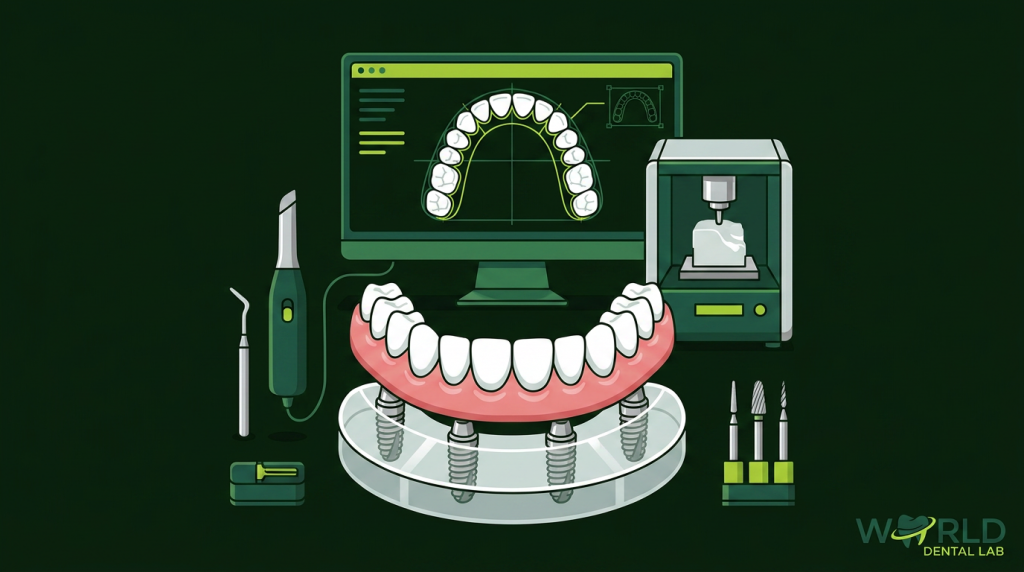
The All-on-4 full-arch implant restoration is the most complex prosthetic that most dental labs produce. It demands precision at every stage — from scan data quality and implant position accuracy to CAD design, milling tolerances, and passive fit verification. When it goes right, the patient receives a fixed, permanent, full-arch restoration that will last decades. When it goes wrong, the consequences are expensive and difficult to correct.
This guide covers the complete lab workflow for zirconia full-arch restorations — from the data the lab needs at the start to the verification steps before delivery — along with realistic timelines and offshore cost benchmarks.
What Is an All-on-4 Prosthetic?
All-on-4 (and the equivalent All-on-6, All-on-X) refers to a full-arch implant-retained prosthetic supported by 4–6 implants per arch. The implants are placed in strategic positions — often with the posterior implants angled to avoid anatomical structures — and a fixed bridge spanning the entire arch is attached to the implants via abutments or multi-unit abutments (MUAs).
The final prosthetic can be monolithic zirconia (most common and most durable), a hybrid of zirconia with acrylic teeth and a titanium bar (for maximum aesthetics and shock absorption), or PMMA for the immediate provisional.
Phase 1: The Provisional Full Arch (PMMA)
Most All-on-4 cases involve a provisional restoration placed immediately after surgery, worn for 3–6 months while osseointegration occurs and soft tissue matures. This is typically milled from PMMA (polymethyl methacrylate) — a strong acrylic that is comfortable on healing tissue, easy to adjust, and inexpensive to remake if needed.
Offshore pricing for a PMMA full-arch provisional: $150–$300 per arch. Production time: 2–4 lab days if the pre-surgical design was completed in advance.
Pre-Surgical Design: The Key to Fast Provisionals
Practices using guided surgery protocols can share the surgical planning data with the lab before the surgery date. The lab designs the provisional based on the planned implant positions, so on the day of surgery, the provisional is already milled and ready — it just needs to be adjusted to the actual implant positions and placed same-day.
This requires the lab to receive CT scan data (DICOM), intraoral or facial scans for the esthetic setup, and the surgical guide file before surgery. The digital workflow here is what makes same-day provisionals possible.
Phase 2: The Final Zirconia Full Arch
After osseointegration (typically 3–6 months), the final prosthetic is fabricated. For most cases, this is a monolithic zirconia full arch — a single piece of zirconia spanning 12–14 teeth, milled from an oversized blank and sintered to final dimensions.
What the Lab Needs to Begin
| Data Required | Format | Purpose |
|---|---|---|
| Implant-level impressions or scan body scans | Physical PVS or digital STL | Precise implant position and orientation in the arch |
| Opposing arch scan/impression | STL or PVS | Occlusal design reference |
| Bite registration | Wax bite or digital bite scan | Centric occlusion relationship |
| Vertical dimension of occlusion (VDO) | Recorded clinically; noted in case sheet | Full arch prosthetic is built to this VDO — cannot be changed after milling |
| Multi-unit abutment (MUA) angles and heights | Noted in case sheet; angulation in degrees | Determines framework angulation for passive fit |
| Implant system and platform | Brand, model, size | MUA compatibility for screw retention |
| Tooth arrangement approval (wax-up or digital approval) | Photo or digital file | Confirms aesthetic outcome before milling |
| Shade/characterization preferences | Shade guide reference + photos | Final staining and characterization of the zirconia |
The CAD Design Process
Full-arch CAD design is the most time-intensive part of the lab process. A skilled technician using exocad or 3Shape typically spends 4–8 hours designing a single full-arch case. The design involves:
- Implant position mapping: Importing scan body data and registering implant positions in the CAD software using the specific implant library
- MUA alignment: Mapping the multi-unit abutment positions and angles — this determines screw access channel locations
- Tooth arrangement: Placing and sculpting 12–14 teeth at the correct VDO, with appropriate overjet, overbite, midline, and smile line
- Framework design: Designing the internal structure for strength — adequate thickness at connectors, pontic tissue contact areas, and transition zones
- Passive fit verification: The digital design must show that all screw access channels align with the MUA positions without angular deviation that would prevent passive fit
- Client approval: Most labs share a 3D render or screenshot of the design for approval before milling, especially for aesthetically demanding cases
Milling the Zirconia Full Arch
Full-arch zirconia restorations require large-format milling machines capable of handling oversized blanks — typically 98–105mm discs. Standard crown/bridge mills (40mm discs) cannot produce full-arch restorations. Confirm that your lab has appropriate equipment before sending the first full-arch case.
Milling a full arch takes 2–4 hours. The restoration is milled approximately 25% oversized in all dimensions to account for sintering shrinkage — a full arch that will be 120mm wide after sintering is milled at ~150mm.
Sintering
The pre-sintered zirconia full arch undergoes a controlled sintering cycle at 1450–1530°C over 6–10 hours (including ramp-up and cool-down). This cannot be rushed — a shortened sintering cycle produces a porous zirconia with reduced strength and translucency. The restoration shrinks precisely to design dimensions during this process.
Finishing and Characterization
After sintering, the full arch is polished, stained with external stains to create tooth characterization (cracks, developmental grooves, gingival shading), and glazed. For cases requiring greater aesthetic depth, the lab may hand-layer porcelain on the facial surfaces — though monolithic cases simply use staining and glazing, which is faster and more durable.
Material Options for Full Arch Restorations
| Material | Pros | Cons | Offshore Price/Arch |
|---|---|---|---|
| Monolithic zirconia | Strongest, most durable, easiest to clean, no chipping risk | Heavier; limited shock absorption vs. acrylic | $600–$1,200 |
| Zirconia-titanium bar hybrid | Lighter; Ti bar distributes load; acrylic/composite teeth more natural | Teeth can chip/wear over time; more complex remake | $900–$1,800 |
| PMMA provisional | Inexpensive; easy to adjust; kind to healing tissue | Not a long-term restoration; wears and stains over time | $150–$300 |
Realistic Turnaround Timeline
| Stage | Time Required |
|---|---|
| Case submission and intake review | 1 day |
| CAD design + client approval | 2–4 days |
| Milling + sintering + finishing | 3–4 days |
| QC and packing | 1 day |
| DHL Express (Asia → US/EU) | 3–5 days |
| Total: case submission to delivery | 10–15 business days |
Rush options are available but limited — design cannot be meaningfully accelerated, and sintering cannot be shortened without compromising material properties. Plan full-arch cases with a minimum 2-week lead time from data submission to seating appointment.
For details on implant-supported bridge design in shorter spans, and our complete outsourcing cost guide for per-arch pricing across all full-arch material types.
Frequently Asked Questions
How long does it take a dental lab to make an All-on-4 prosthetic?
From submission of complete case data to delivery: 10–15 business days for an overseas lab. The design phase alone takes 2–4 days; sintering takes 1–2 days; DHL transit adds 3–5 days. Rush cases with simplified designs can occasionally be completed in 7–10 days, but this requires complete data upfront and no design approval round.
What is the cost of an All-on-4 zirconia prosthetic from an overseas dental lab?
A monolithic zirconia full arch runs $600–$1,200 per arch at quality overseas labs. A PMMA provisional runs $150–$300. A zirconia-titanium bar hybrid runs $900–$1,800. Shipping adds $60–$100 for full-arch cases due to larger box sizes. Domestic US lab pricing for equivalent work runs $3,000–$6,000+ per arch.
Can All-on-4 zirconia full arches be made from digital scans?
Yes — and digital workflows are strongly preferred. Using a scan body at the implant level produces the most accurate positional data. However, for full-arch cases, many experienced implant surgeons still prefer physical polyether or PVS impressions for final restorations, as scan stitching errors across a full arch can affect passive fit. Discuss with your lab their preference and success rate with digital vs. physical impressions for full-arch cases.
