
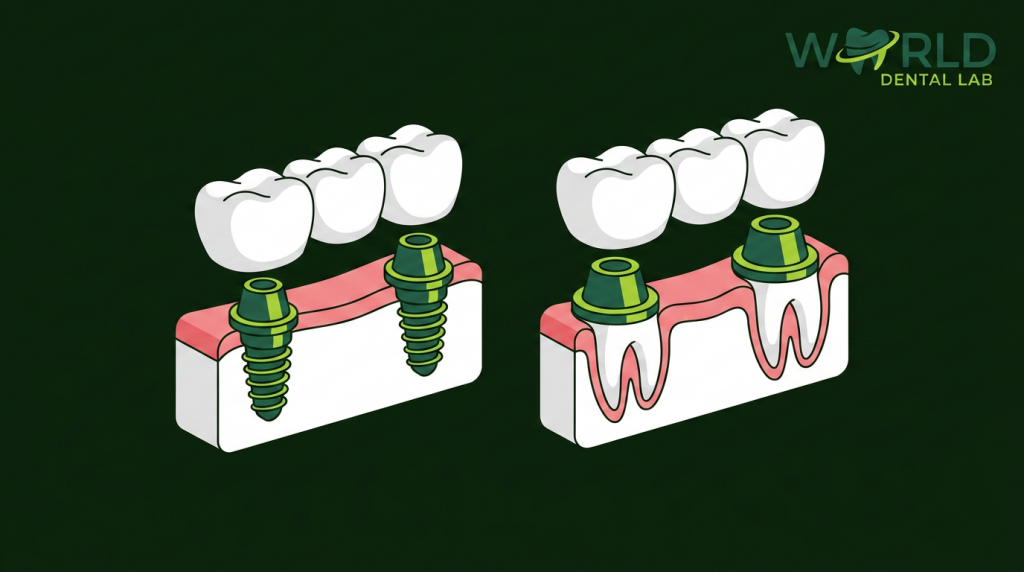
When a patient is missing one or more teeth, a dental bridge is one of the most common solutions. But “bridge” now covers two fundamentally different approaches: the traditional tooth-supported bridge, where adjacent natural teeth act as abutments, and the implant-supported bridge, where titanium implants in the jawbone provide support. Understanding the differences in design, procedure, cost, and outcomes is essential for treatment planning.
What Is a Traditional Tooth-Supported Bridge?
A conventional dental bridge spans a gap by crowning the two teeth on either side of the missing tooth (or teeth) — called abutment teeth — and suspending a pontic (artificial tooth) between them. The abutment teeth are prepared (ground down significantly) to accept the crowns, and the bridge is cemented in place as a fixed, non-removable prosthesis.
Typical structure: two abutment crowns + one or more pontics, all fused into a single unit.
What Is an Implant-Supported Bridge?
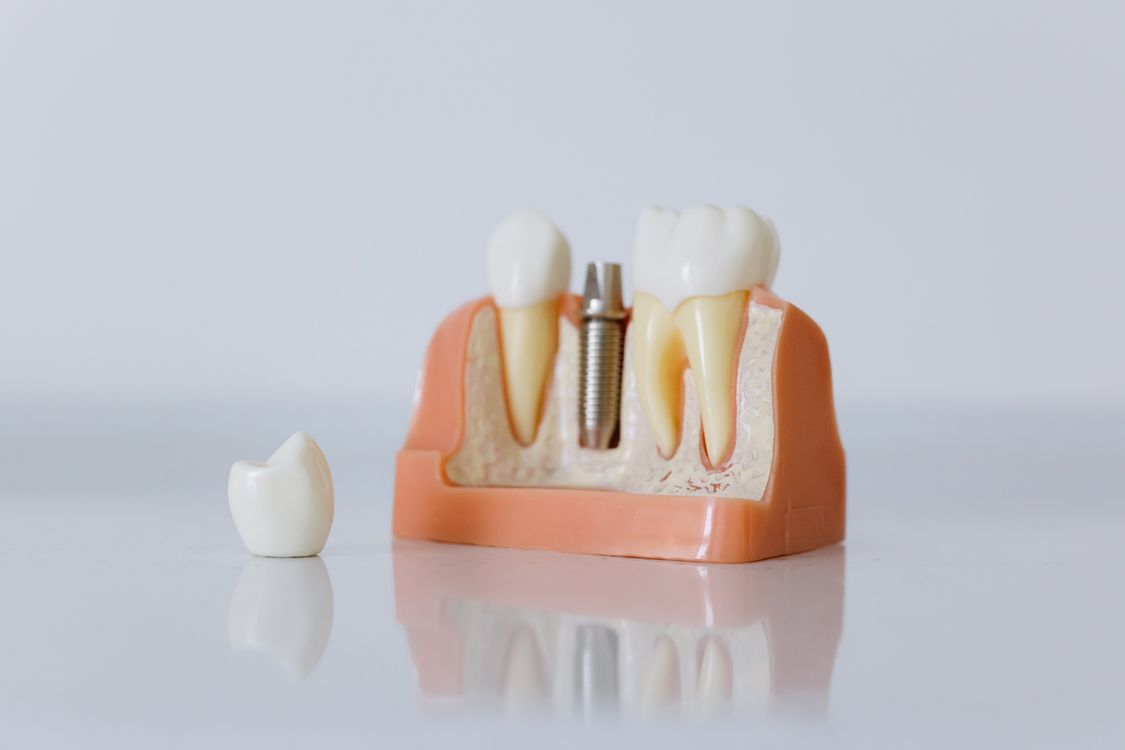
An implant-supported bridge replaces missing teeth using titanium implants placed surgically into the jawbone as abutments. The bridge prosthesis attaches to the implants — either with screw retention or cemented onto implant abutments. No natural teeth are involved in the support structure.
Key advantage: adjacent teeth are left completely untouched.
Comparison: Implant-Supported vs Traditional Bridge
| Factor | Traditional Bridge | Implant-Supported Bridge |
|---|---|---|
| Adjacent tooth preparation | Significant grinding required | No preparation needed |
| Bone preservation | Bone resorption continues under pontic | Implant stimulates bone — preserves ridge |
| Surgery required | No | Yes — implant placement + healing period |
| Treatment timeline | 2–3 weeks | 3–6 months (including osseointegration (bone integration with the implant — typically 3–6 months). For a broader overview of bridge options including all span types and materials, see our Dental Bridge Types Guide. For implant restoration comparisons, also read All-on-4 vs All-on-6. The word osseointegration) |
| Average lifespan | 10–15 years | 20+ years (implant can be lifelong) |
| Upfront cost (AUD) | $3,000–$6,000 | $6,000–$12,000+ |
| Hygiene difficulty | Difficult (floss threader needed) | Easier (space under bridge for cleaning) |
| Best for | Patients with compromised adjacent teeth needing crowns anyway; limited budget | Patients with healthy adjacent teeth; long-term solution seekers |
Bone Resorption: The Critical Long-Term Difference
When a natural tooth is lost, the jawbone beneath it begins to resorb (shrink) because it no longer receives the stimulation provided by the tooth root. A traditional bridge replaces the crown of the tooth but not the root — so bone resorption under the pontic continues. Over years, this can create an aesthetic issue as the ridge collapses and a gap forms under the pontic.
A dental implant functions like an artificial tooth root — the titanium post transmits biting forces into the bone, maintaining stimulation and preventing resorption. This makes implant-supported bridges significantly better for long-term ridge preservation and facial structure.
When to Choose a Traditional Bridge
- Adjacent teeth already need crowns due to existing decay or large restorations — preparing them for a bridge adds no additional tooth sacrifice
- Patient is not a surgical candidate (anticoagulants, uncontrolled diabetes, active smoking)
- Insufficient bone volume for implant placement and patient declines bone grafting
- Budget constraints requiring a lower upfront cost
- Short treatment timeline needed (patient unable to commit to 3–6 month implant healing)
When to Choose an Implant-Supported Bridge
- Adjacent teeth are healthy and unrestored — grinding them down would sacrifice good tooth structure
- Multiple adjacent missing teeth (implant-supported spans are stronger and more aesthetic)
- Patient is young — implants can last a lifetime; traditional bridges will need replacement
- Adequate bone volume exists for implant placement
- Patient prioritises long-term outcomes over lower short-term cost
Lab Considerations: How Each Bridge Is Made
From a laboratory perspective, these two bridge types require quite different workflows:
Traditional bridge: The lab works from a conventional impression or digital scan of the prepared abutment teeth. The bridge is designed and milled (or pressed) to fit the prepared tooth margins. Fit verification is on the stone die.
Implant-supported bridge: The lab works from an implant-level or abutment-level scan. The bridge must match the implant platform exactly — using the correct implant system library in the CAD software. Passive fit across all implant connection points is essential. A poorly fitting implant bridge can cause implant failure.
For labs outsourcing their bridge work, it’s critical that the offshore lab has experience with your specific implant systems and can demonstrate accurate implant library data. At World Dental Lab, we maintain over 200 implant system libraries for major brands used across Australia, the UK, and USA.
Bridge Fabrication at World Dental Lab
We fabricate both traditional and implant-supported bridges in zirconia, e.max, and PFM. Our CAD/CAM system includes libraries for all major implant systems.
