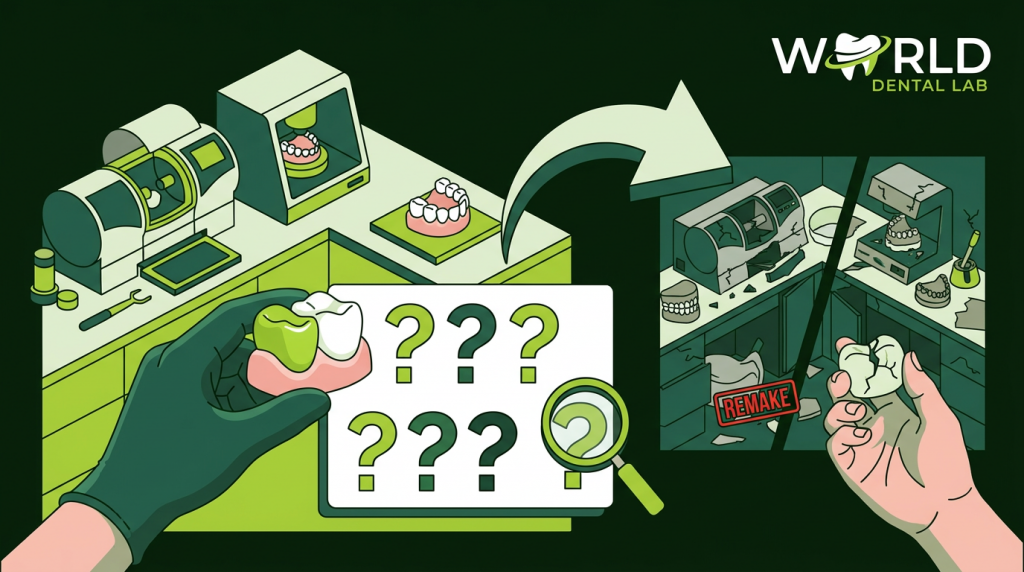
The dental lab outsourcing market has grown significantly over the past decade — and so has the range of lab quality. Choosing the wrong partner means remakes, delays, patient complaints, and the time cost of switching mid-stream. Choosing the right partner means a reliable, low-effort workflow that reduces your per-unit cost without adding clinical risk.
This guide gives you 7 specific questions to ask any prospective outsourcing partner — with what to look for in the answers and what answers should disqualify a lab from consideration.
Question 1: Do You Hold ISO 13485 Certification?
What to look for: A current ISO 13485 certificate with certificate number, issuing body name, scope statement, and expiry date.
ISO 13485 is the international quality management standard for medical device manufacturers. Dental restorations are medical devices. An ISO 13485-certified lab maintains documented quality procedures, material traceability, device history records, and nonconformance management processes — the same system used by major dental manufacturers.
How to verify: Ask for the certificate document. Note the issuing certification body (e.g., BSI, TÜV, Bureau Veritas, SGS). You can verify the certificate is valid by contacting the certifying body directly. Be cautious of labs that say they “operate to ISO 13485 standards” without a certificate — this is not the same as certified compliance.
Disqualifier: Cannot produce a current certificate, or certificate scope does not cover dental restorations. For full detail on what ISO 13485 means for dental labs, see our ISO 13485 dental lab guide.
Question 2: What Materials Do You Use, Specifically?
What to look for: Named brands and grades — not marketing language like “premium quality zirconia” or “high-grade ceramic.”
Material quality has an outsized effect on clinical longevity, shade stability, and patient outcomes. The price difference between a branded zirconia blank (e.g., Katana UTML, Cercon HT) and a no-name generic may be $5–$10 per blank. The clinical difference can be significant over a 10-year restoration lifespan.
What to ask specifically:
- Which zirconia brand and grade? (Katana, Cercon, BruxZir, IPS e.max Zircad are premium options)
- Which e.max product? (IPS e.max CAD or Press from Ivoclar — not generic lithium disilicate)
- Which staining and glazing materials? (Ivoclar, VITA, and GC brands are most verifiable)
- Which CAD software? (3Shape Dental Designer, exocad DentalCAD are the industry standards)
Disqualifier: Cannot or will not name specific material brands. This is a significant red flag — it usually indicates generic or unverifiable material sourcing.
Question 3: What Is Your Warranty Policy?
What to look for: A written warranty covering both material defects and fabrication errors for at least 1 year. 2 years is the premium market standard.
A warranty is the clearest signal of a lab’s confidence in their own work. Labs with low remake rates and high-quality materials offer long warranties because they rarely need to honor them. Labs with quality concerns offer short warranties or warranties with many exclusions.
What the warranty should cover:
- Material fracture under normal clinical use
- Delamination or chipping (for layered restorations)
- Shade inaccuracies that don’t match the submitted prescription
- Margin fit issues traceable to fabrication rather than prescription
Disqualifier: No written warranty, warranty shorter than 12 months, or warranty that excludes all fracture events as “patient misuse.”
Question 4: What Is Your Remake Rate?
What to look for: A remake rate below 3%. Top-performing labs report 1–2%.
This is a question most labs won’t volunteer an answer to — but it is the single most useful quality metric available. A low remake rate means fewer disrupted patient appointments, less time managing quality issues, and lower true total cost (even if per-unit price is higher).
How to approach this question: Ask directly: “What percentage of cases result in a remake or adjustment request?” A lab that hesitates, deflects, or cannot answer has either not measured it or does not want to disclose it. A lab that answers confidently with a specific number has a quality measurement system in place.
Cross-check this yourself: After 20–30 cases, calculate your own remake rate with the partner. This is more reliable than their self-reported figure. For pricing context on remake economics, see our dental lab outsourcing cost guide.
Question 5: What Is Your Turnaround Time — and What Is Your On-Time Rate?
What to look for: Specific production turnaround (e.g., “3 business days from case acceptance”), clear shipping timeframe, and an on-time rate above 95%.
Most labs will quote a turnaround time. Fewer will tell you how often they meet it. An on-time rate below 90% means roughly 1 in 10 cases arrives late — causing appointment cancellations, patient dissatisfaction, and staff time managing delays.
How to evaluate this:
- Ask for the turnaround SLA and whether it is guaranteed or target
- Ask what happens if they miss a turnaround — credit, rush on remake, no recourse?
- Ask which shipping carrier is used and whether tracking is provided per case
- Run trial cases with deliberate attention to turnaround performance
For benchmark turnaround times by restoration type and route, see our dental lab turnaround time guide.
Question 6: How Do You Handle Case Communication and Queries?
What to look for: A dedicated communication channel, same-day response to queries during working hours, and a named account contact.
Communication quality is one of the most significant differentiators between outsourcing labs — and one of the hardest to evaluate from a quote request alone. The best way to test it is to ask a specific pre-sale question and measure the response: How long did it take? Was the answer direct and specific, or vague? Did they ask clarifying questions about your case mix?
Red flags:
- Response time over 24 hours for a standard enquiry
- No dedicated case manager or named contact — email goes into a generic inbox
- Communication only available during hours that don’t overlap with your working day (critical for time-zone differences)
- Inability to provide case status updates during production
Question 7: Can I Run Trial Cases Before Committing Volume?
What to look for: Yes, offered proactively, with no minimum volume commitment for trials.
This question is as much about attitude as policy. A lab that offers trial cases confidently — ideally before you ask — is confident in their quality. A lab that hesitates, requires a minimum order before allowing trials, or charges full price for trial cases is a warning sign.
What trial cases to run:
- At least one single-unit posterior crown (your most common case type)
- At least one anterior crown requiring accurate shade matching
- At least one multi-unit bridge
- If relevant: one implant-supported crown to test implant interface accuracy
Evaluate each case against these criteria: margin fit (requires try-in or stone model check), shade accuracy, contact accuracy, occlusal contacts, surface finish, and packaging quality.
Evaluation Scorecard
Use this scorecard to compare multiple labs side by side:
| Criterion | Weight | Lab A | Lab B | Lab C |
|---|---|---|---|---|
| ISO 13485 certified | 25% | /5 | /5 | /5 |
| Named material brands | 20% | /5 | /5 | /5 |
| Warranty (2yr = 5/5) | 15% | /5 | /5 | /5 |
| Trial case quality | 25% | /5 | /5 | /5 |
| Communication responsiveness | 10% | /5 | /5 | /5 |
| Turnaround reliability | 5% | /5 | /5 | /5 |
Evaluate World Dental Lab as Your Partner
World Dental Lab is ISO 13485-certified, uses named premium materials (Katana UTML, IPS e.max, 3Shape CAD), offers a 2-year warranty, and accepts trial cases with no minimum volume commitment. We serve labs and practices in 32 countries.
