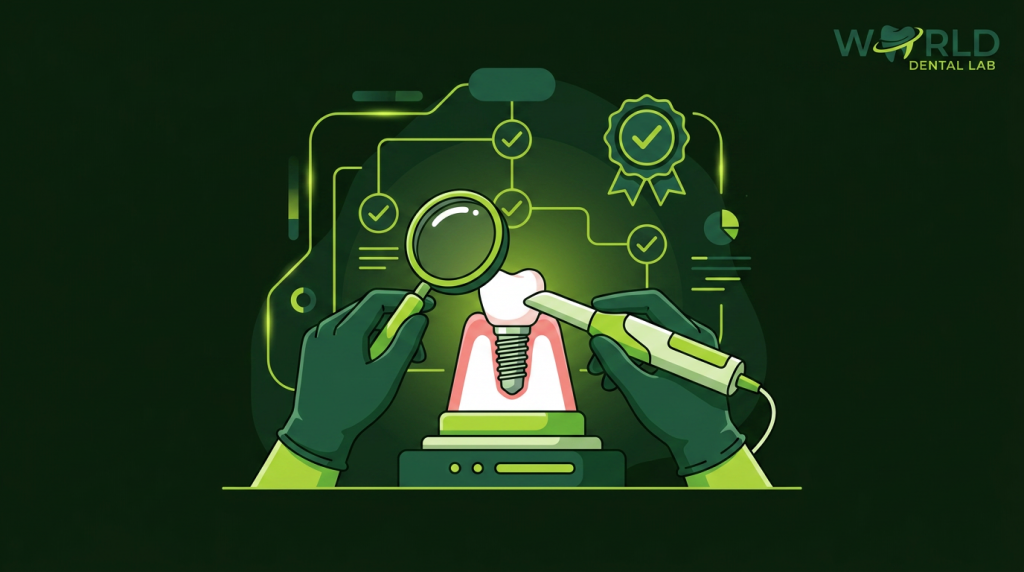
When evaluating an offshore dental lab partner, ISO 13485 certification is one of the most important credentials to look for. But what does ISO 13485 actually require — and why does it matter more than a lab simply claiming “high quality”? This guide answers both questions clearly.
What Is ISO 13485?
ISO 13485:2016 is the international standard specifying requirements for a quality management system (QMS) where an organisation needs to demonstrate its ability to provide medical devices and related services that consistently meet customer and applicable regulatory requirements.
Dental restorations — crowns, bridges, veneers, implants, dentures, splints — are classified as medical devices under most national regulatory frameworks: FDA in the USA, MHRA in the UK, TGA in Australia, and CE in the EU. ISO 13485 is the quality management standard designed specifically for manufacturers in this regulatory environment.
Importantly, ISO 13485 is a system standard — it doesn’t specify how strong a crown must be. It specifies how the organisation’s processes must be managed to consistently produce safe, effective devices.
Key Requirements of ISO 13485 for Dental Labs
1. Documented Quality Management System
- Quality manual describing the QMS scope and structure
- Documented procedures for all critical production processes
- Work instructions at the point of production
- Records demonstrating that procedures were followed for each case
2. Risk Management
Formal risk management is required throughout the product lifecycle — identifying what could go wrong and how each risk is controlled. For dental labs, this includes material failure, shade mismatch, margin fit error, patient ID mix-up, and shipping damage.
3. Supplier Control
The lab must evaluate and qualify all material suppliers — ensuring zirconia blanks, ceramic powders, metal alloys, and other consumables come from suppliers meeting defined specifications. Batch certificates and material traceability records are required.
4. Production and Process Controls
- Equipment calibration and maintenance records (sintering furnaces, milling units, pressure pots)
- Process validation for critical steps — sintering cycles, pressing programmes, casting parameters
- In-process and final inspection records for each restoration
- Environmental controls where required
5. Traceability
Every restoration must be traceable to: the patient, the prescribing dentist, the prescription details, materials used (batch numbers), and the technicians who produced it. This enables root cause investigation if a device fails clinically.
6. Post-Market Surveillance
The lab must track complaints, remake requests, and adverse events — investigating root causes and implementing corrective actions. Systematic analysis of remake patterns drives continuous quality improvement.
ISO 13485 vs. ISO 9001
| Feature | ISO 9001 | ISO 13485 |
|---|---|---|
| Scope | General quality management | Medical device quality management |
| Risk management | Risk-based thinking (general) | Formal risk management required |
| Regulatory compliance | Not device-regulation specific | Designed to meet FDA, CE, TGA, MHRA |
| Patient traceability | General traceability | Strict per-device, per-patient traceability |
| Relevant for dental labs? | Partially | Yes — purpose-built for this context |
Why ISO 13485 Matters When Choosing an Outsourcing Lab
When a lab holds ISO 13485 certification, it means:
- An independent, accredited certification body has audited the lab’s processes against the standard’s requirements
- The lab maintains documented procedures — not just good intentions
- Production is controlled, traceable, and subject to formal corrective action when things go wrong
- Certification is maintained through regular surveillance audits — typically annually
A lab without ISO 13485 may still produce good restorations — but without independent verification, you rely entirely on the lab’s self-assessment. For most labs and practices — especially those importing restorations under FDA, MHRA, or TGA oversight — ISO 13485 certification is the minimum quality credential to require.
For a broader framework for evaluating outsourcing partners, see: How to Choose a Dental Lab Outsourcing Partner: 7 Key Questions.
Questions to Ask a Lab About Their Quality System
- Are you ISO 13485 certified? Can you provide a copy of your certificate?
- Which certification body issued your certificate?
- When was your last surveillance audit?
- Can you provide material certificates for the restorations you produce?
- How do you handle remake requests and complaints?
- Do you maintain per-patient traceability records?
World Dental Lab Quality Credentials
World Dental Lab operates under a documented quality management system. Our quality documentation and material certificates are available to partners on request.
