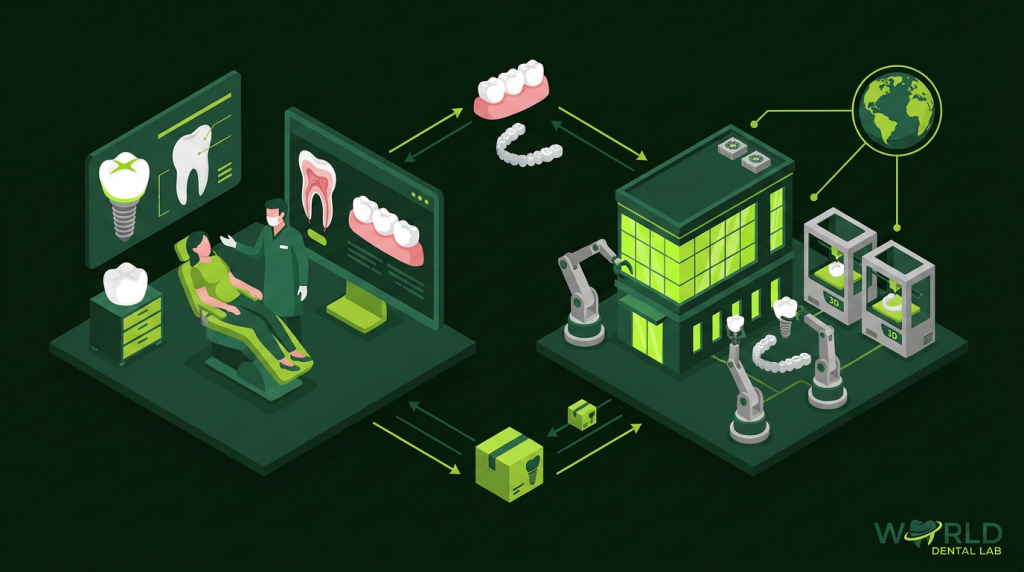
Dental lab outsourcing is the practice of sending dental restoration work — crowns, bridges, implants, veneers, clear aligners, and more — to an external laboratory rather than producing it in-house. For dental practices, it means working with a commercial lab instead of maintaining an in-house technician. For dental labs, it means sending overflow or specialist work to a partner lab, typically offshore, to reduce costs and expand capacity.
This guide covers everything you need to make informed outsourcing decisions: what types of work can be outsourced, how to evaluate a partner, what quality and compliance look like, realistic cost and turnaround benchmarks, and a step-by-step process for getting started.
What Is Dental Lab Outsourcing?
Dental lab outsourcing refers to any arrangement where restoration fabrication is performed by a party other than the practice or lab ordering the work. It operates at two levels:
- Practice-to-lab outsourcing: A dental practice sends impressions or scan data to a commercial dental laboratory, which fabricates the restoration and returns it ready to seat. This is the standard model for most practices — the practice does not employ an in-house dental technician.
- Lab-to-lab outsourcing: A dental laboratory subcontracts specific work to another lab — typically for cost reduction, specialist capability, or capacity management. The subcontracting lab manages the relationship with the practice; the end lab fabricates the restoration. International (offshore) lab-to-lab outsourcing is the primary focus of this guide.
The offshore model — where a lab in a lower-labour-cost country fabricates work on behalf of a domestic lab or practice — has grown substantially since digital workflows eliminated the physical delivery bottleneck for most restoration types. When a restoration is designed as an STL file and milled, it can be designed in Vietnam, milled in Vietnam, and delivered to Australia in 3–5 business days without a quality compromise.
What Types of Dental Work Can Be Outsourced?
Almost all fixed and removable prosthetics can be outsourced. Digital workflow compatibility determines which cases are suited for offshore outsourcing specifically:
| Restoration Type | Offshore-Suitable? | Notes |
|---|---|---|
| Zirconia crowns (monolithic) | ✅ Ideal | Fully digital; STL-to-production workflow |
| Zirconia bridges (3–6 unit) | ✅ Ideal | Digital design; DHL delivery in 3–5 days |
| E.max crowns and veneers | ✅ Ideal | Pressed or CAD — both outsource well |
| PFM crowns and bridges | ✅ Good | Requires physical model; slightly longer process |
| Implant crowns (screw-retained) | ✅ Ideal | Provide implant brand/model/platform |
| All-on-4 / All-on-6 full arch | ✅ Good | Complex; trial fitting steps add lead time |
| Clear aligners (per arch) | ✅ Ideal | STL and staging files — fully digital |
| CAD/CAM design only (STL output) | ✅ Ideal | Design offshore, mill locally |
| Diagnostic wax-ups | ✅ Digital wax-ups | Digital wax-ups (STL output) outsource well |
| Partial dentures (RPD) | ⚠️ Mixed | Framework can be digital; try-in adds lead time |
| Complete dentures | ⚠️ Mixed | Multiple fitting stages; better for local outsourcing |
Why Labs and Practices Outsource
The economics of in-house dental lab production are challenging. A skilled dental technician in Australia earns AUD $60,000–$90,000 per year. In the UK, £28,000–£40,000. In the US, $45,000–$75,000. Labour accounts for 50–60% of total production cost for most restoration types.
Outsourcing to a qualified offshore partner typically reduces per-unit cost by 50–70% while maintaining equivalent quality — verified by ISO 13485-certified quality management systems, the same certification standard used by major dental manufacturers.
Beyond cost, labs and practices outsource for:
- Capacity expansion without hiring — absorb case volume growth without adding technician headcount
- Specialist access — access technician skill sets (complex implant prosthetics, full-arch zirconia) not available in-house
- Technology access — partner labs running 5-axis mills, sintering furnaces, and high-specification equipment without capital outlay
- Risk reduction — reduce dependency on a single in-house technician; avoid production stoppage from staff illness or turnover
- Focus — allow practice staff and in-house technicians to focus on the work that benefits most from proximity to the patient
Cost Benchmarks: What to Expect in 2026
For offshore outsourcing, these are typical price ranges for common restoration types. For a full breakdown by category, see our dental lab outsourcing cost guide.
| Restoration | Offshore Range | Typical Domestic (US) |
|---|---|---|
| Monolithic zirconia crown | $18–$40 | $90–$160 |
| E.max crown | $30–$65 | $130–$230 |
| Implant crown (zirconia) | $40–$85 | $150–$280 |
| 3-unit zirconia bridge | $55–$120 | $270–$480 |
| Full-arch zirconia (All-on-4/6) | $600–$1,400 | $2,500–$5,000 |
| E.max veneer | $30–$65/unit | $130–$250/unit |
| Clear aligner (per arch) | $99–$199 | $250–$450 |
| CAD design only (STL) | $5–$15/unit | $20–$40/unit |
Note: prices vary based on material specification, volume, and partner. These figures represent offshore rates from Vietnam-based labs using premium materials (Katana UTML zirconia, IPS e.max). Budget labs using unbranded materials will quote lower; always ask for material specification.
Turnaround Time: Realistic Expectations
Digital workflows have dramatically reduced the time penalty of offshore outsourcing. For complete guidance, see our dental lab turnaround time guide.
| Stage | Digital Submission | Physical Impression |
|---|---|---|
| Case arrival at lab | Same day / minutes | 3–7 days (international shipping) |
| Production time | 1–3 business days | 1–3 business days |
| Return shipping to client | 2–5 days (DHL Express) | 2–5 days (DHL Express) |
| Total lead time | 3–8 business days | 6–15 business days |
For practices that have transitioned their clinical partners to intraoral scanning, total lead time from impression to restoration in hand is typically 5–8 business days for standard cases — comparable to many domestic commercial labs.
Quality and Compliance: What to Look For
Quality in dental lab outsourcing is verifiable. The key signals to evaluate:
ISO 13485 Certification
ISO 13485 is the international quality management standard for medical device manufacturers. Dental restorations are regulated as medical devices in most markets (Class I or Class II depending on jurisdiction). An ISO 13485-certified lab maintains documented quality procedures, material traceability, device history records, and nonconformance management — the same processes that major dental manufacturers like Ivoclar and Dentsply follow.
ISO 13485 certification is audited annually by an accredited third-party body. Ask for the certificate number and verify it directly with the certifying body. For full detail, see our ISO 13485 guide for dental labs.
Material Specification
Ask which zirconia brand and grade is used. Premium options include Katana UTML (Kuraray Noritake), Cercon HT (Dentsply Sirona), and BruxZir (Glidewell). For e.max, ensure IPS e.max CAD or Press (Ivoclar) is specified — not generic lithium disilicate. Material quality is the primary driver of long-term clinical success; price alone is a poor guide.
Remake Rate
A well-run lab should have a remake rate below 2–3%. Ask prospective partners what their remake rate is and what their warranty policy covers. A 2-year warranty covering material and fabrication defects is a strong indicator of quality confidence. A lab offering a 90-day warranty or no warranty should be evaluated carefully.
Trial Case Protocol
Any credible outsourcing lab will offer free or reduced-cost trial cases. Run 3–5 trial cases across your most common restoration types before committing volume. Evaluate: margin fit, shade accuracy, contact accuracy, occlusal contacts, surface finish, and packaging. Remake rate on your own cases is the most useful quality signal you can obtain.
7 Key Criteria for Evaluating an Outsourcing Partner
For a detailed checklist with evaluation questions for each criterion, see our guide to choosing a dental lab outsourcing partner. In summary:
- ISO 13485 certification — verifiable certificate with number and expiry
- Material specification — named brands, not generic “high-quality zirconia”
- Warranty terms — minimum 1 year; 2 years is the market standard for premium labs
- Communication responsiveness — how quickly do they respond to quote requests and case queries?
- Digital workflow compatibility — which CAD software, which scan formats accepted?
- Turnaround reliability — on-time rate, not just quoted turnaround
- Volume scalability — can they absorb your growth without quality degradation?
Regulatory Compliance by Market
Dental restorations are regulated as medical devices in all major English-language markets. The lab fabricating the restoration must comply with the relevant framework:
- Australia (TGA): Dental prostheses are Class I medical devices. Labs supplying into Australia must comply with TGA requirements. ISO 13485 is accepted as evidence of compliance. For details, see our dental lab outsourcing Australia guide.
- United Kingdom (MHRA): Custom-made devices (dental restorations) must comply with the UK MDR 2002. Labs must be able to provide a Declaration of Conformity. For details, see our dental lab outsourcing UK guide.
- United States (FDA): Dental devices are regulated under 21 CFR Part 820. Most dental restorations are Class II medical devices requiring 510(k) clearance or predicate equivalence. For details, see our dental lab outsourcing USA guide.
How to Get Started: Step-by-Step Process
Step 1: Identify Your Case Mix
List the restoration types you want to outsource by volume. Identify which are digital workflow-ready (scan data available) and which require physical impressions. Start with the highest-volume, most standardised cases — typically monolithic zirconia crowns.
Step 2: Shortlist 2–3 Partners
Request quotes from multiple labs. Ask each for: ISO certificate, material specification sheet, warranty policy, sample cases or portfolio, and turnaround time guarantee. Compare across these dimensions, not just price.
Step 3: Run Trial Cases
Submit 3–5 representative cases to each shortlisted partner. Evaluate quality against your in-house or current lab standard. Include at least one aesthetically demanding anterior case and one multi-unit posterior case.
Step 4: Set Up Digital Workflow
Establish the submission process: how scan files will be sent, which formats are accepted, how case forms are submitted, and how communication will work for queries and remakes. Agree on a turnaround SLA in writing.
Step 5: Start With a Volume Subset
For the first 1–3 months, route a defined subset of cases (e.g., single-unit zirconia crowns only) to the outsourcing partner. Evaluate quality, turnaround reliability, and communication before expanding the case mix.
Step 6: Review and Scale
After 30–60 cases, review: remake rate, turnaround adherence, communication quality, and patient/clinician satisfaction. Adjust volume allocation based on performance. Most labs reach full volume integration within 90 days.
Common Questions About Dental Lab Outsourcing
Is the quality of offshore dental restorations equivalent to domestic labs?
Quality depends on the specific lab, not its location. An ISO 13485-certified offshore lab using Katana UTML zirconia and 3Shape CAD software produces restorations to the same material specification as a domestic lab using identical inputs. The differentiator is the quality management system and technician skill — both of which are verifiable. Many offshore labs operate at lower remake rates than average domestic labs because they are specialists rather than generalists.
Who is legally responsible for the restoration if something goes wrong?
The prescribing dentist and the dental lab that supplies the restoration both bear responsibility depending on the nature of the failure. Material or fabrication defects are the lab’s responsibility (covered by warranty). Prescription errors or improper cementation are the prescriber’s responsibility. A formal supply agreement with the outsourcing lab should specify responsibilities, warranty coverage, and the procedure for remakes and replacements.
How does outsourcing work for implant cases?
Implant cases are well-suited to offshore outsourcing when submitted digitally with scan body data. The key requirement is providing the implant system information (brand, model, platform diameter) with the case. The lab sources the compatible prosthetic components or designs to the correct interface. For screw-retained implant crowns, the crown and abutment assembly is returned ready to torque into place. For full-arch cases, interim try-in steps may require additional turnaround time.
What happens if a restoration doesn’t fit?
A credible outsourcing lab has a documented remake procedure. Contact the lab with photographs of the issue and a description. Fabrication defects (incorrect margin, wrong shade, incorrect occlusal contact) are remade at no charge under warranty. Cases where the original scan data was inadequate (incomplete margin, distorted bite) may require rescanning. Response time for remake approval should be under 24 hours; production of the remake within standard turnaround.
Can I outsource CAD design only and mill locally?
Yes — CAD-only outsourcing (receiving STL design files to mill locally) is a growing model. At $5–$15 per design, it allows in-house milling capacity to be fully utilized while removing the design labor cost. This works particularly well for labs with milling equipment but limited CAD technician capacity.
How do I handle patient information privacy when sending scan data offshore?
Send scan data with patient ID codes rather than full names — most lab management software supports this. Ensure your outsourcing partner has a data processing agreement (DPA) or equivalent privacy documentation compliant with your jurisdiction (GDPR for UK/EU, Privacy Act for Australia, HIPAA for US). Most professional outsourcing labs have these documents ready.
Get Started with World Dental Lab
World Dental Lab is an ISO 13485-certified laboratory based in Vietnam, serving dental labs and practices in 32 countries. We produce 50,000+ restorations per month across all major categories.
