
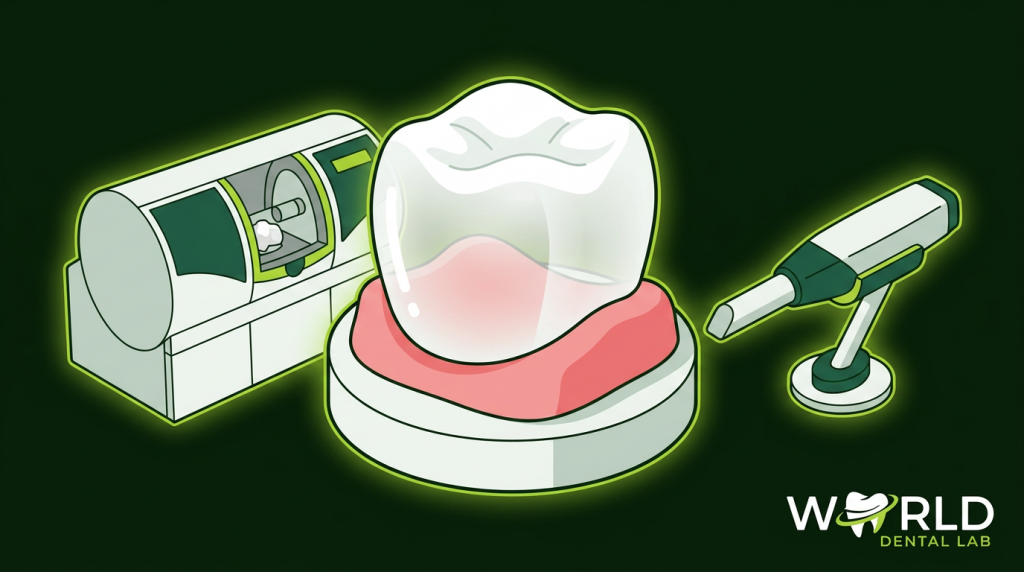
Zirconia has become the dominant crown material in modern dentistry. Its combination of strength, biocompatibility, and improving aesthetics has displaced porcelain-fused-to-metal (PFM) as the standard of care in many clinical situations. This guide covers everything dental labs and clinicians need to know about zirconia crowns in 2026.
What Is Zirconia?
Zirconia (zirconium dioxide, ZrO₂) is a ceramic material stabilized with yttrium oxide (Y₂O₃) to prevent phase transformation. In dentistry, it is used in pre-sintered blocks that are milled into the desired restoration shape, then sintered at high temperature to achieve final density and strength.
Key physical properties that make zirconia ideal for crowns:
- Flexural strength: 900–1,200 MPa (monolithic) — far exceeding porcelain or PFM
- Fracture toughness: 5–10 MPa·m½
- Biocompatibility: Excellent — low ion release, no known allergenicity
- Radiopacity: Similar to enamel — visible on radiograph without obscuring adjacent structures
Generations of Zirconia: 1st Through 5th
Zirconia technology has evolved significantly over the past decade. Understanding generations helps labs and clinicians select the right material for each case.
1st Generation (3Y-TZP)
3 mol% yttria-stabilized tetragonal zirconia polycrystal. Extremely high strength (~1,200 MPa) but opaque appearance — limited to posterior framework use or where aesthetics are secondary.
2nd Generation (Layered Zirconia)
Zirconia substructure veneered with feldspathic porcelain. Improved aesthetics, but veneer chipping was a known complication rate of 5–15% at 5 years.
3rd Generation (Multi-layered / Gradient Zirconia)
Gradient translucency blocks (e.g., Katana UTML, IPS e.max ZirCAD Prime) with higher translucency in the incisal zone. Strength ~700–900 MPa. Most widely used for monolithic anterior and posterior crowns today.
4th Generation (High-Translucency Zirconia)
5Y-PSZ and 4Y-PSZ materials with cubic phase content increasing translucency to near-glass levels. Strength trades off (~400–600 MPa) — appropriate for single-unit anteriors but not for high-load posterior or bridge situations.
5th Generation (Ultra-Translucent Zirconia)
Newest ultra-high-translucency zirconia materials targeting esthetic parity with lithium disilicate. Still under evaluation for long-term clinical data.
Monolithic vs. Layered Zirconia: Which to Choose?
| Factor | Monolithic | Layered |
|---|---|---|
| Strength | Higher (700–1,200 MPa) | Lower substructure exposed if chipping |
| Chipping risk | None (no veneering porcelain) | 5–15% at 5 years |
| Esthetics | Good with modern materials | Excellent (hand-layered) |
| Cost | Lower | Higher |
| Best for | Most posterior, many anterior cases | High-demand anterior esthetics |
Zirconia Crown Milling: Key Lab Parameters
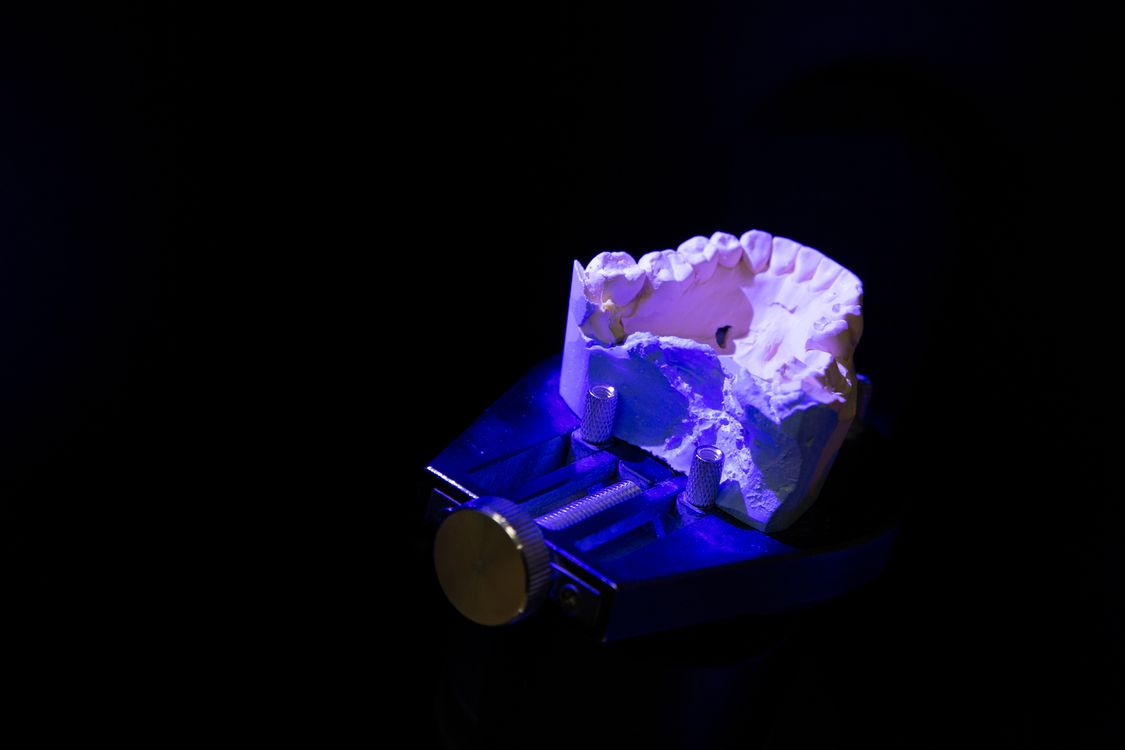
Proper milling protocol is critical for crown fit and longevity. Key parameters for dental labs:
- Pre-sintering enlargement factor: 18–25% (material-dependent) to compensate for sintering shrinkage
- Milling bur diameter: 0.6 mm minimum for fine detail; 1.0 mm for bulk reduction
- Sintering temperature: Typically 1,400–1,500°C depending on material
- Sintering time: 2–8 hours (fast-sintering protocols available in 90 minutes)
- Margin thickness: Minimum 0.3 mm for adequate strength
Cementation Protocols for Zirconia Crowns
Zirconia requires specific surface treatment for reliable adhesive bonding:
- Air abrasion: 50–100 µm alumina at 2–3 bar pressure for 5–10 seconds
- MDP-containing primer: Apply Clearfil Ceramic Primer or equivalent — MDP chemically bonds to ZrO₂
- Cement selection: Resin cement (RelyX Ultimate, Panavia V5) for adhesive cementation; RMGI acceptable for well-retained preparations
Avoid hydrofluoric acid etching — zirconia does not respond to HF, which is appropriate only for glass-ceramics like e.max.
Clinical Indications and Contraindications
Ideal indications:
- Posterior single-unit crowns (all loading conditions)
- Implant-supported crowns
- Short-span posterior bridges (monolithic, 3Y-TZP)
- Anterior crowns where translucency is acceptable
- Patients with metal allergies
Relative contraindications:
- Demanding anterior esthetics where feldspathic or e.max is preferred
- Very short clinical crowns (under 3 mm) — prep design is critical
Ordering Zirconia Crowns From an Outsourcing Lab
When outsourcing zirconia crown production, specify the following to your lab partner:
- Zirconia generation/translucency level (e.g., “multi-layered, standard translucency”)
- File format: STL (scan bodies + prep + opposing arch + bite registration)
- Shade (VITA Classical or 3D-Master)
- Cement space: typically 30–50 µm
- Margin design preference (knife-edge, chamfer, shoulder)
World Dental Lab produces zirconia crowns in all current material generations, with standard 5-day and rush 2-day turnaround options. See our full product catalog and CAD/CAM design service.
Order Zirconia Crowns From World Dental Lab
We produce zirconia crowns for dental labs and clinics in 32 countries. 2-year warranty, white-label packaging, rush turnaround available.
