
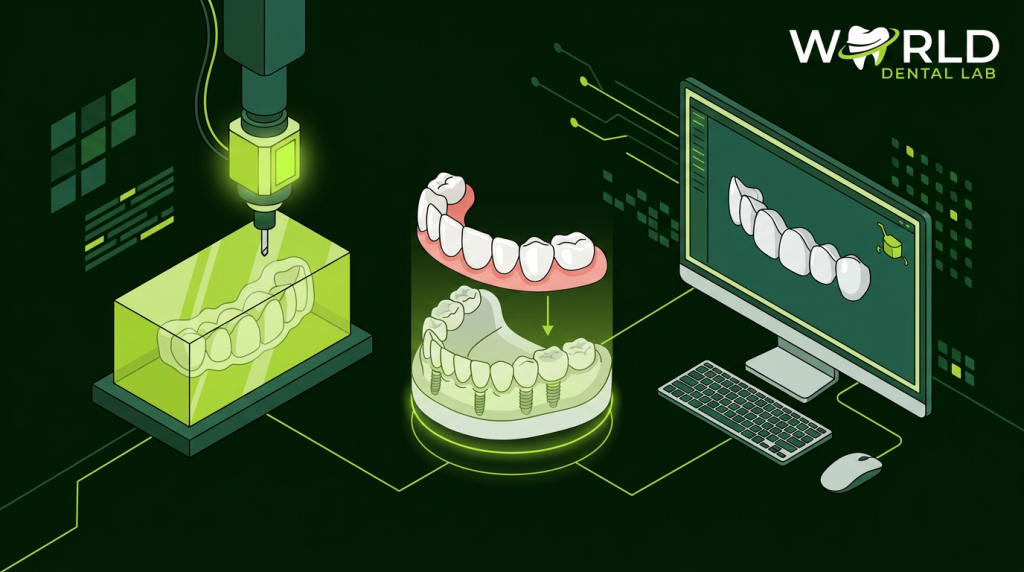
PMMA (polymethyl methacrylate) temporaries have been a staple of dental practice for decades. What has changed dramatically in the past five years is how they are produced. Chairside mixed acrylic is giving way to CAD/CAM-milled PMMA — offering superior strength, accuracy, and aesthetics, with a production workflow that fits seamlessly into digital implant and restorative protocols. This guide covers everything dental labs and clinicians need to know.
What Is PMMA?
Polymethyl methacrylate (PMMA) is a transparent thermoplastic acrylic resin widely used in dentistry for temporary crowns, bridges, and full-arch provisional restorations. When produced via CAD/CAM milling from pre-polymerised blocks, PMMA has significantly better properties than chairside-mixed or conventionally processed acrylic.
Key properties of milled CAD/CAM PMMA:
- Flexural strength: 80–110 MPa (higher than conventional acrylic at 50–70 MPa)
- Low porosity — pre-polymerised blocks have no air inclusions
- Dimensional accuracy — no polymerisation shrinkage after milling
- Available in tooth shades (VITA Classical and 3D-Master)
- Excellent polishability — can achieve high surface lustre
- Biocompatible — safe for mucosal contact for provisional durations
Clinical Uses of PMMA Temporaries
1. Single-Unit Provisional Crowns and Bridges
The most common use — a temporary crown or bridge produced while the permanent restoration is being fabricated. CAD/CAM PMMA temporaries provide better fit and aesthetics than chairside-made alternatives, and can be produced directly from the preparation scan without a separate impression.
2. Implant Immediate Loading Temporaries
In immediate implant loading protocols (same-day implant + temporary crown), a PMMA temporary is essential. The requirements are strict:
- Must be out of occlusion — no loading on the implant during the healing period
- Must protect the soft tissue emergence profile
- Must be aesthetic enough for the patient to accept during the 3–6 month healing period
- Must be easy to remove and reattach for follow-up appointments
CAD/CAM PMMA temporaries designed from the implant scan deliver all of these requirements with high precision.
3. Full-Arch Immediate Loading (All-on-4 / All-on-6)
This is the most demanding PMMA temporary application. In a same-day full-arch implant protocol, the patient leaves surgery with a full-arch temporary prosthesis in place. This temporary must:
- Seat passively on all implants simultaneously — no stress on the healing bone
- Be strong enough to survive 3–6 months of function
- Define the correct vertical dimension of occlusion and anterior guidance
- Allow the clinician to verify aesthetics and phonetics before committing to the final restoration
Full-arch PMMA temporaries are typically reinforced with a titanium or PEEK bar to prevent fracture across the arch span.
4. Diagnostic Temporaries for Occlusal Changes
When changing vertical dimension, correcting anterior guidance, or rehabilitating a worn dentition, PMMA temporaries allow the clinician and patient to evaluate the proposed changes in function for weeks or months before fabricating the final porcelain or zirconia restorations. The temporary validates the plan — reducing risk in complex cases. See our related guide: Diagnostic Wax-Up: The Foundation of Predictable Restorations.
CAD/CAM PMMA Milling: Lab Parameters
Milling PMMA is considerably easier than milling zirconia or e.max:
- Milling speed: 2–3× faster than zirconia — PMMA is softer and less demanding on burs
- Bur life: Much longer bur life compared to ceramic milling
- No sintering required: PMMA is used directly after milling — massive time saving vs. zirconia’s 2–8 hour sintering cycle
- Dry milling: PMMA is typically milled dry — no coolant required
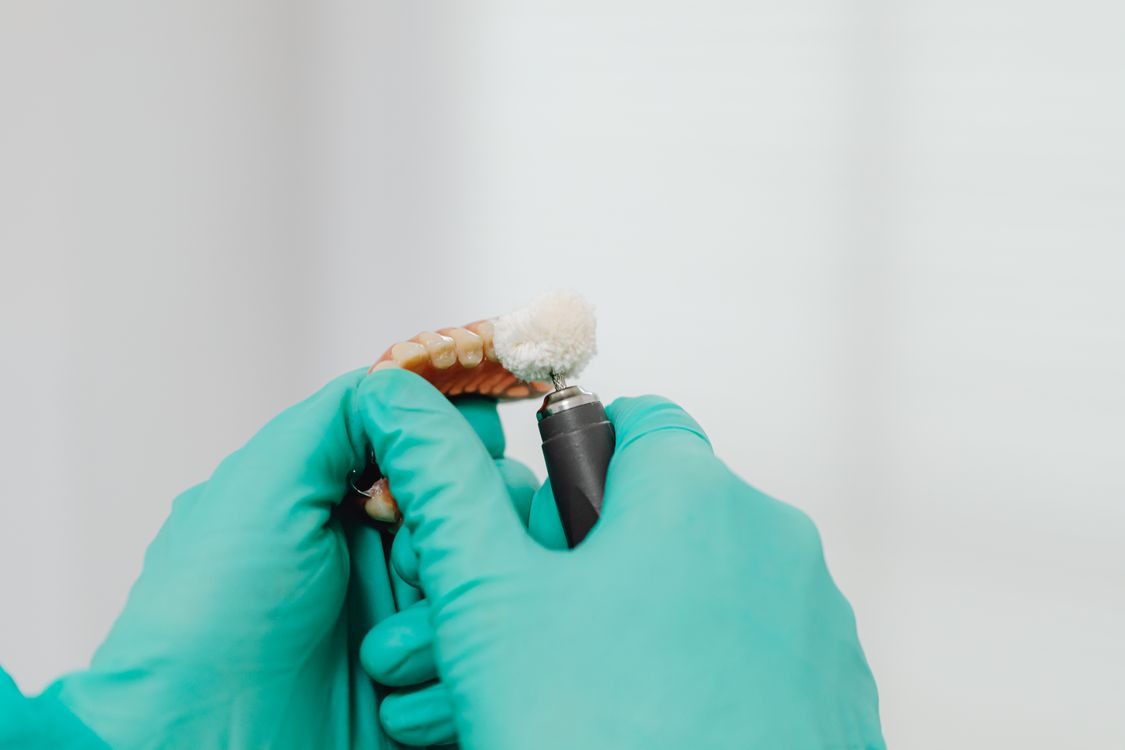
- Finishing: Polishing with RA burs and polishing paste; no glaze firing needed
Total production time for a PMMA single crown: approximately 30–45 minutes from CAD design to finished temporary.
PMMA vs. Bis-GMA Composite Temporaries
| Property | CAD/CAM PMMA | Bis-GMA Composite Block |
|---|---|---|
| Strength | 80–110 MPa | 100–140 MPa |
| Cost per block | Lower | Higher |
| Repairability | Good (acrylic bonding) | Excellent (composite bonding) |
| Shade range | Full VITA range | Full VITA range + multi-layered |
| Best for | Short-term provisionals (up to 12 months) | Longer-term provisionals or final in some cases |
Order PMMA Temporaries From World Dental Lab
We produce single-unit and full-arch PMMA temporaries for dental labs and clinics in 32 countries. Same-day production for urgent cases.
