
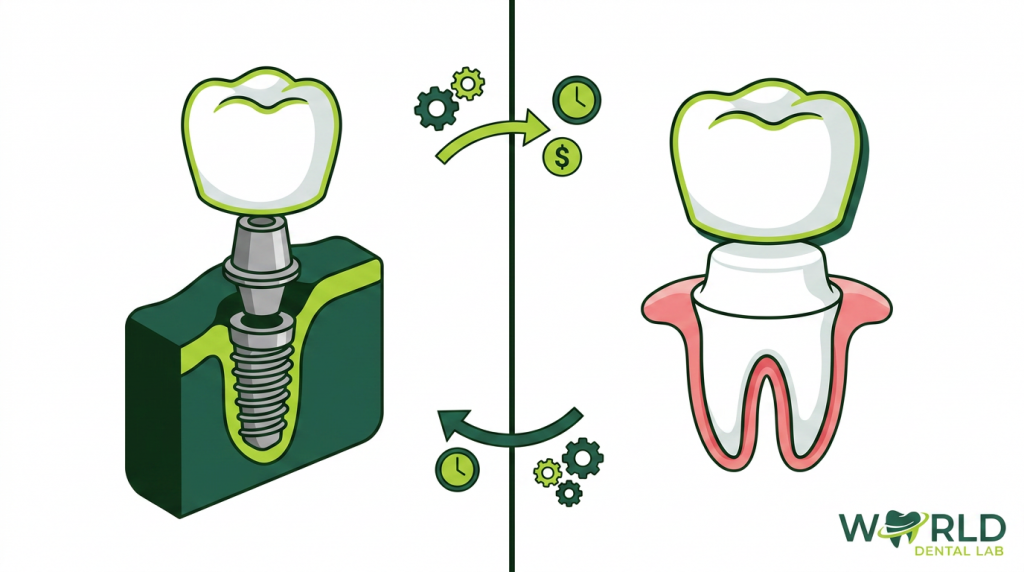
An implant crown and a regular (tooth-supported) crown serve the same functional purpose — replacing or restoring a single tooth — but they are fundamentally different restorations from the lab’s perspective. The design logic, materials, retention mechanism, and production workflow diverge at almost every step.
Understanding these differences helps you write better case instructions, avoid common errors, and accurately predict turnaround times and costs when outsourcing to an overseas dental lab.
The Core Difference: How the Crown Connects to the Mouth
A regular crown sits over a prepared natural tooth or a post-and-core buildup. The tooth structure provides the abutment. Retention comes from cement and the mechanical resistance form of the preparation. The crown must fit tightly over a tapered preparation with a defined margin.
An implant crown connects to a titanium implant fixture in the bone — either directly via a screw through the crown (screw-retained) or through an intermediate abutment that the crown cements onto (cement-retained). There is no natural tooth. The connection geometry is dictated by the implant system, not the patient’s anatomy.
This single difference — the connection point — drives nearly every downstream difference in the lab workflow.
Head-to-Head Comparison
| Factor | Regular Crown | Implant Crown |
|---|---|---|
| Abutment | Prepared natural tooth or buildup | Titanium implant fixture + abutment |
| Retention mechanism | Cement + resistance form | Screw (preferred) or cement on abutment |
| Margin location | Supragingival or subgingival on tooth | At implant platform level (tissue-level) or abutment shoulder |
| Lab design freedom | Constrained by tooth anatomy | Greater — lab designs full emergence profile |
| Common materials | Zirconia, e.max, PFM, gold | Zirconia (dominant), titanium-based for screw access |
| Screw access channel | Not applicable | Required for screw-retained; must align with implant axis |
| Implant system compatibility | Not applicable | Critical — must match platform, connection type, hex |
| Offshore lab cost | $18–$65/unit (by material) | $40–$150/unit (crown + abutment) |
| Lab turnaround | 3–5 lab days | 4–7 lab days (abutment + crown) |
Implant Crown Design: What the Lab Needs to Know
The Implant System Is Non-Negotiable Information
For a regular crown, the lab works from your scan or impression and designs to fit the preparation. For an implant crown, the lab must know:
- Implant brand: Straumann, Nobel Biocare, Zimmer, Osstem, Neodent, etc.
- Implant diameter and platform size: e.g., Straumann BL 4.1mm with RC (Regular CrossFit) platform
- Connection type: Internal hex, external hex, conical (Morse taper), tri-channel
- Implant depth and angulation: Affects emergence profile design
- Retention preference: Screw-retained or cement-retained
Without this information, the lab cannot produce the correct abutment. An implant crown made for the wrong connection type is useless — it will not seat on the fixture. This is the most common serious error in implant case submissions to overseas labs, and it is always caused by incomplete case instructions from the practice.
Screw-Retained vs Cement-Retained: The Lab Implications
| Factor | Screw-Retained | Cement-Retained |
|---|---|---|
| Lab design requirement | Screw access channel through crown (labial or occlusal) | Crown cements onto custom abutment; no screw hole |
| Clinical retrievability | Retrievable — remove screw, lift crown | Difficult to retrieve without damaging crown |
| Aesthetics (anterior) | Screw access can be visible; requires careful placement | Better — no access hole to conceal |
| Excess cement risk | None | Subgingival cement excess is a peri-implantitis risk |
| Currently preferred approach | Yes — ITI consensus favors screw-retained where possible | Still used for poor implant angulation cases |
| Lab cost difference | Similar — screw access milled during production | Similar — abutment fabrication is the main variable |
The Emergence Profile
One aspect of implant crown design that has no equivalent in regular crowns is the emergence profile — the contour of the restoration from the implant platform through the soft tissue to the crown margin.
Unlike a natural tooth, where the emergence form is determined by tooth anatomy, an implant crown must create an emergence profile that supports the peri-implant soft tissue. Too convex and the tissue becomes ischemic; too concave and plaque accumulates in the sulcus.
A quality lab will design the emergence profile based on the implant position, the soft tissue height information you provide, and established guidelines. For anterior cases, consider sharing photos of the soft tissue contour so the lab can shape the profile accordingly.
Custom Abutment vs. Stock Abutment
For cement-retained implant crowns, the practice has a choice: use a stock abutment from the implant manufacturer, or order a custom abutment from the lab.
| Abutment Type | Offshore Lab Cost | Best For |
|---|---|---|
| Stock titanium abutment (practice-supplied) | Crown only: $40–$65 | Ideal angulation, standard gingival height |
| Custom titanium abutment (lab-fabricated) | $45–$80 (abutment only) | Angulated implants, aesthetic anterior cases, non-standard tissue heights |
| Zirconia custom abutment | $50–$90 (abutment only) | Anterior aesthetics requiring tissue-colored subgingival portion |
| Ti-base with zirconia abutment-crown | $85–$140 (complete) | Best anterior aesthetic outcome; retrievable; recommended for anterior implants |
For posterior implant cases with acceptable angulation, a stock abutment with a lab-fabricated screw-retained zirconia crown is the most cost-effective approach at $40–$75/unit. For anterior cases, a custom titanium or zirconia abutment with an e.max or HT zirconia crown delivers better aesthetic outcomes at $85–$150/unit complete.
Materials for Implant Crowns
Implant crowns experience slightly different load dynamics than tooth-supported crowns — the absence of a periodontal ligament means implants have no proprioceptive feedback, so occlusal forces can be higher before the patient perceives overload. This is one reason monolithic zirconia is even more strongly preferred for posterior implant crowns than for tooth-supported restorations.
- Posterior implant crown: Monolithic zirconia (3Y-TZP), screw-retained. The gold standard combination in 2026.
- Anterior implant crown: Layered zirconia or e.max on a custom titanium or zirconia abutment. HT zirconia is a viable lower-cost option for cases where shade matching demands are moderate.
- Full arch implant bridge: Monolithic zirconia framework (All-on-4, All-on-6). Layered zirconia for premium aesthetics. See our guide on implant-supported bridges for full-arch specific considerations.
Turnaround Times: Why Implant Cases Take Longer
A straightforward monolithic zirconia tooth crown takes 2–3 lab days to produce. An implant crown with a custom abutment takes 4–7 lab days for several reasons:
- Abutment design: The lab must design the custom abutment to the implant specification before designing the crown — these are two separate CAD steps
- Titanium milling: Custom titanium abutments are milled on metal milling equipment (not ceramic mills), which may not always be immediately available
- Fit verification: Some labs produce a printed verification jig before milling the final abutment, adding a day
- Crown fabrication: Only after the abutment is complete can the crown be designed against the abutment geometry
For digital workflows where the scan body is used, the lab can begin abutment design immediately — no physical impression of the implant position is needed. This is where digital case submission for implant cases offers the biggest time advantage. See our dental lab outsourcing cost guide for implant-specific pricing across different restoration scenarios.
Frequently Asked Questions
Is an implant crown more expensive than a regular crown?
Yes, generally. The total lab cost for an implant crown (crown + custom abutment) runs $85–$150 offshore versus $18–$65 for a regular crown depending on material. The additional cost reflects the abutment fabrication, implant system compatibility work, and additional design complexity.
Do I need to send a scan body scan for implant cases?
Yes, for digital workflows. A scan body (implant-level impression coping for intraoral scanners) records the implant position and orientation in the digital scan. Without the scan body data, the lab cannot design a correctly positioned abutment. Scan bodies are system-specific — use the scan body specified for your implant system.
Can any overseas dental lab make implant crowns?
Not all labs have the full range of implant analog and scan body libraries for every major system. Before sending an implant case, confirm the lab has your specific implant system in their digital library (for CAD design) and that they have access to titanium milling for custom abutments. Most established overseas labs support Straumann, Nobel Biocare, Zimmer, Osstem, Neodent, and Megagen as a minimum.
