
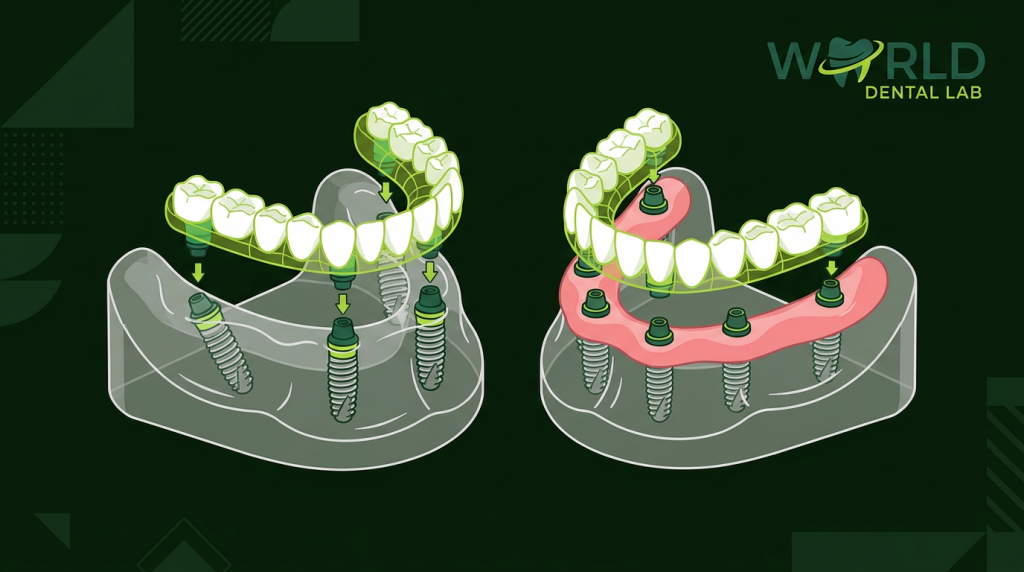
Full-arch implant restorations are among the most complex and high-value prosthetic cases a dental lab produces. Understanding the difference between All-on-4 and All-on-6 protocols — not just the implant count, but the prosthetic implications — is essential for labs that want to produce these cases consistently and profitably.
What Is All-on-4?
The All-on-4 protocol, developed by Dr. Paulo Maló at Nobel Biocare in the early 2000s, uses four dental implants to support a full-arch fixed prosthesis. The two posterior implants are tilted at 30–45° to engage more bone, avoid critical anatomical structures (sinus, inferior alveolar nerve), and maximise the anterior-posterior (AP) spread without requiring bone grafting.
Key characteristics:
- 4 implants per arch (2 anterior, 2 tilted posterior)
- Immediate loading protocol — temporary prosthesis fitted same day as surgery
- Avoids bone grafting in most cases
- Fewer implants = lower initial surgical cost
- AP spread typically 20–22 mm
What Is All-on-6?
All-on-6 uses six implants per arch, typically placed more evenly distributed along the arch. Posterior implants may still be angled but are often placed more upright. The additional two implants provide more distribution of occlusal load and redundancy.
Key characteristics:
- 6 implants per arch (usually 2 anterior, 4 posterior or more even distribution)
- Greater load distribution — lower force per implant
- More appropriate in cases with significant bone resorption requiring greater support
- More implants = higher surgical cost but potentially better long-term prognosis
Clinical Comparison: All-on-4 vs All-on-6
| Factor | All-on-4 | All-on-6 |
|---|---|---|
| Implants per arch | 4 | 6 |
| Bone grafting required | Rarely | Sometimes |
| Surgical complexity | Moderate | Moderate–High |
| Load distribution | Higher force per implant | Better distributed |
| Cantilever length | Typically longer | Shorter |
| Failure impact | Higher — 1 lost = 25% fewer | Lower — 1 lost = 17% fewer |
| Cost to patient | Lower | Higher |
What the Lab Needs to Know: Prosthetic Design Implications
Cantilever Design
All-on-4 cases typically require a posterior cantilever to replace second molars — since the most posterior implant rarely reaches the molar position. The standard guideline is a cantilever no longer than 1.5× the AP spread. For a 20 mm AP spread, this means a maximum 30 mm cantilever.
All-on-6 cases generally have better posterior implant coverage, reducing or eliminating cantilever length requirements — which reduces prosthetic stress.
Screw Access Channel Angulation
Tilted posterior implants in All-on-4 mean the screw access channels exit at an angle that may compromise the occlusal surface aesthetics or create access challenges. Labs designing screw-retained. Related reading: Implant Crown vs Regular Crown | Implant Bridge vs Traditional Bridge | PMMA Temporaries Guide. Screw-retained prostheses for All-on-4 cases must account for this angulation — either with angled screw access channels (ASC) using compatible abutments, or by discussing cement-retained options with the clinician.
Materials: Zirconia vs Titanium-Acrylic
Full-arch prostheses are most commonly produced in two material configurations:
- Monolithic zirconia: Milled from full-arch zirconia disc — high strength, no acrylic components, durable. Requires precise fit across all implant connections simultaneously (passive fit). Higher lab production cost.
- Titanium bar with acrylic/zirconia teeth: Metal framework provides structural rigidity; acrylic or zirconia teeth are set into the bar. More technique-sensitive, but allows easier tooth replacement if individual teeth fracture.
For All-on-4 with longer cantilevers, a titanium bar may be preferred — it distributes stress differently than monolithic zirconia under cantilever loading. See our full-arch zirconia guide for detailed material information.
Ordering Full-Arch Implant Cases: What the Lab Needs
- Implant brand, system, and platform details for all implants
- Scan body scans with all scan bodies in place simultaneously
- Opposing arch scan
- Bite registration at correct vertical dimension of occlusion (VDO)
- Facebow transfer (strongly recommended)
- Wax rim records or existing temporary prosthesis scan
- Treatment plan: All-on-4 or All-on-6, screw-retained. Related reading: Implant Crown vs Regular Crown | Implant Bridge vs Traditional Bridge | PMMA Temporaries Guide. Screw-retained or cement-retained, material preference
Full-Arch Implant Prosthetics From World Dental Lab
We produce All-on-4 and All-on-6 full-arch prostheses in monolithic zirconia and titanium bar configurations for labs in 32 countries.
